Oakworth Station became so recognizable because several histories meet on one modest platform. It is an attractive Victorian station, a survivor of the Worth Valley’s industrial railway age, a carefully restored piece of working heritage and, for millions of viewers, the station from The Railway Children. None of those qualities entirely explains its appeal alone. Together, they have made a small village stop feel like part of Britain’s shared railway memory.
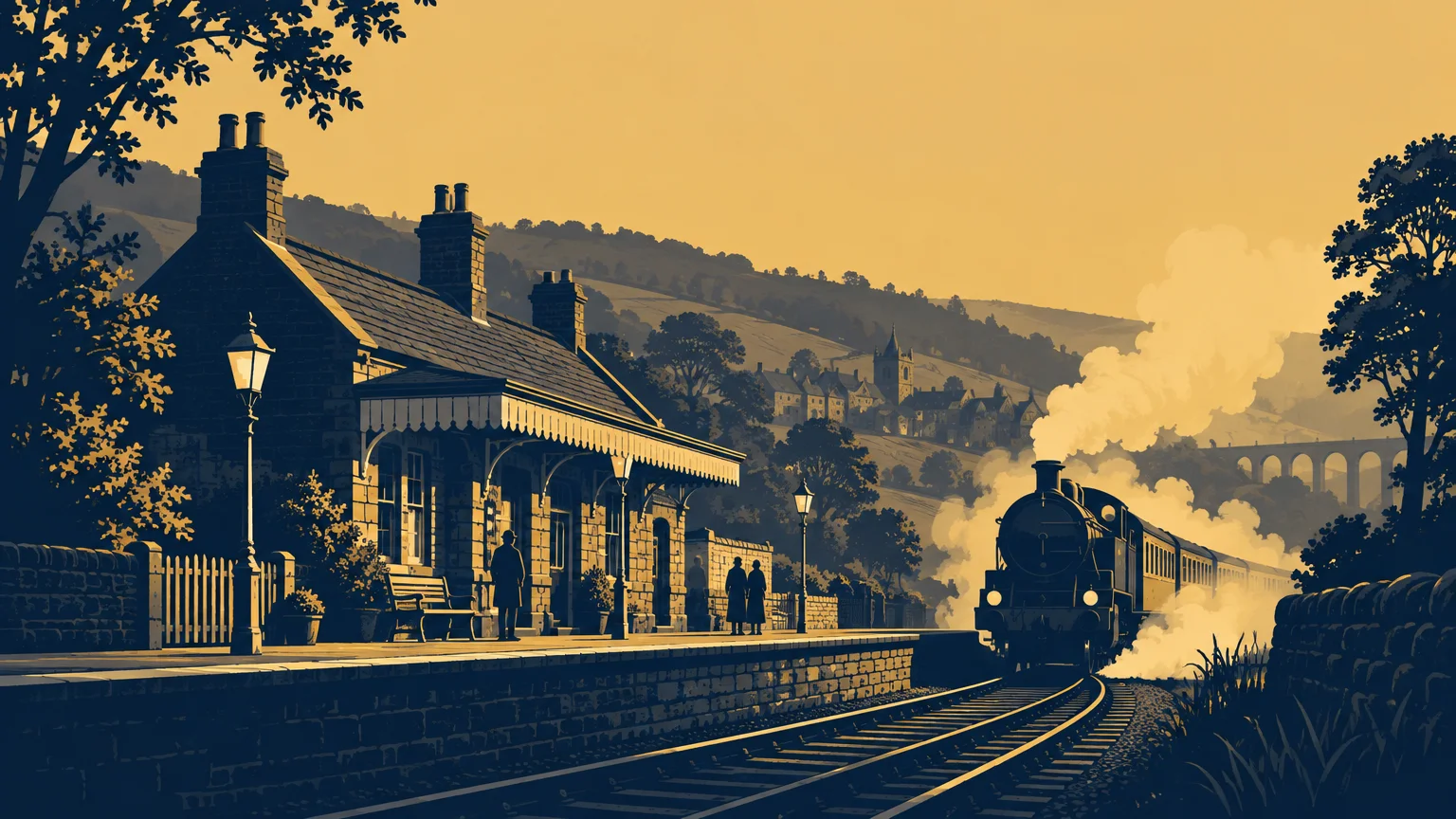
The station is not a grand terminus or an architectural showpiece built to impress a city. Its character comes from a more intimate scale: warm stone, round-headed openings, a slate roof, old-fashioned signs, crossing gates and rooms that look ready for the next porter or passenger. Steam trains still arrive beside them. That unity of building, platform, railway and landscape is what makes Oakworth more than a preserved backdrop.
A station built for the working Worth Valley
Oakworth opened for passenger business on 15 April 1867. The railway had been built to connect Keighley with the villages and mills of the Worth Valley, with local mill owners among its principal funders. Coal traffic was especially important in a textile district whose mills depended on steam power. Goods services on the branch followed on 1 July 1867.
That industrial purpose matters when looking at the station today. Oakworth may now suggest leisurely excursions and period films, but it began as part of a practical transport system. The line carried people, fuel and goods through a valley shaped by manufacturing. Bradford Council’s conservation assessment describes the railway as an important late-19th-century addition that served the settlements between Keighley and Oxenhope and helped local growth.
The branch was operated by the Midland Railway, passed to the London, Midland and Scottish Railway at the 1923 grouping and became part of British Railways at nationalisation in 1948. At Oakworth, the railway also marked a change in the route’s geography: the line left the River Worth valley and followed the Bridgehouse Beck valley towards Haworth and Oxenhope.
Evidence of the station’s working life remains beyond the passenger building. The site retains its goods yard, livestock dock and five-ton crane. These features help explain Oakworth as a place where agricultural and commercial traffic once met the railway, rather than merely as a picturesque halt.
The dates that shaped Oakworth Station
| Date | What happened | Why it matters |
|---|---|---|
| 15 April 1867 | Oakworth opened to passengers. | The village gained a direct place on the Worth Valley branch. |
| 1 July 1867 | Goods services began on the line. | The railway served the valley’s industrial and commercial economy as well as passengers. |
| 1956 | The passing loop and Keighley-end signal box were removed. | Their removal reflected declining passenger and goods traffic. |
| 1 January 1962 | British Railways closed Oakworth to passengers. | The station’s original public-service era ended. |
| 1965 | The preservation society acquired the station keys. | The largely intact building entered preservation. |
| 28 June 1968 | The revived railway reopened, including Oakworth. | The station returned as part of a working heritage line. |
| 8–12 June 1970 | Scenes for The Railway Children were filmed at Oakworth. | The station acquired the screen identity that still draws visitors. |
| 4 December 1986 | The station received Grade II listing. | Its architectural and historic interest gained statutory recognition. |
This sequence shows why Oakworth feels unusually complete. Closure came late enough for the station to retain much of its railway identity, while preservation came early enough to prevent a long period of dereliction or redevelopment. According to the Keighley & Worth Valley Railway, the preservation society acquired the keys in 1965 and found much of the building apparently left as it had been at closure.
Architecture that rewards a closer look
Oakworth’s visual strength begins with the original 1867 building. The official Historic England listing for Oakworth Railway Station describes a single-storey stone structure with ashlar dressings and a slate roof. Its central section is gabled, while round-arched openings, moulded details, keystones, a modillion cornice and stone chimneys give the small station a surprising architectural richness. The plainer section to the right is a later addition.
These details explain why the building reads so clearly on screen. The central gable provides a strong focal point, while the arches and stonework establish a period character without the scale overwhelming the people in front of it. A child, porter or waiting family can remain the centre of a scene, yet the station is distinctive enough to be remembered.
It is important, however, not to assume that every visible fitting has remained untouched since 1867. Bradford Council’s Oakworth Conservation Area Assessment says the station was refurbished in a style appropriate to about 1910 for The Railway Children, using fittings accurate to that date. Oakworth is therefore best understood as a preserved Victorian station presented with a strongly Edwardian character, rather than as a building frozen unchanged on its opening day.
That distinction does not diminish its authenticity. It makes the story more interesting. Oakworth contains original fabric, later railway alterations and preservation-era restoration, all arranged to evoke a coherent period. Historic England records complete internal fittings and restoration to the original state, while the council assessment helps identify the early-20th-century presentation visitors now recognize.
Closure, survival and careful repair
By the middle of the 20th century, traffic had declined. Oakworth’s passing loop and the signal box at the Keighley end were removed in 1956, and British Railways closed the station to passenger traffic on 1 January 1962. Yet the branch did not disappear beneath housing or a new road. Preservation gave the station a second working life when the revived Keighley & Worth Valley Railway opened on 28 June 1968.
Preservation was not simply a matter of unlocking the doors and polishing the signs. A serious outbreak of dry rot in 1983 required extensive work to the entrance hall and much of the original building. The episode is a useful reminder that heritage survives through repeated maintenance, specialist repair and volunteer effort, not through nostalgia alone.
Oakworth received Grade II listed status on 4 December 1986. The listing recognized the architectural and historic interest of a station that had already survived closure, reopened under preservation and become known to cinema audiences.
The railway remains operational rather than static. A crossing keeper works the remaining signals from a small ground frame at the Haworth end when trains approach or leave. Visitors therefore encounter old railway practices as part of a functioning journey, not only as objects behind glass. This continuing role is central to why Oakworth Station still matters to the village.
How The Railway Children changed Oakworth’s identity
Oakworth’s widest recognition arrived with Lionel Jeffries’ 1970 film adaptation of E. Nesbit’s The Railway Children. The British Film Institute records filming at the station from 8 to 12 June 1970, including scenes involving Bernard Cribbins and Jenny Agutter.
The film repeatedly returns to Oakworth. It serves as porter Albert Perks’s workplace and provides the setting for the final platform reunion, one of the story’s most remembered moments. The real station name was retained rather than replaced by Meadow Vale, the fictional name used in Nesbit’s novel. As a result, audiences did not merely remember the appearance of the place; they remembered Oakworth itself.
The station suited the story because it was believable at close quarters. Its platform was large enough for arrivals, departures and crowds, but intimate enough for domestic drama. The surrounding stone, timber fittings and railway furniture created an early-20th-century atmosphere without requiring Oakworth to pretend to be a vast or glamorous station.
The preserved Perks room strengthens that connection for admirers of the film. The BFI’s guide to The Railway Children’s Yorkshire locations notes both the room’s survival and Oakworth’s continuing attraction for visitors. The KWVR attributes an increase in visitors to the film’s release; that is the railway’s own account rather than an independently measured estimate, but the enduring stream of film-related tours, walks and return visits makes the cultural association plain.
Oakworth’s screen history did not end in 1970. The station was used again for The Railway Children Return, released in 2022, alongside Keighley, Damems and Oxenhope stations. Screen Yorkshire describes the sequel’s story as bringing evacuee children and an injured American soldier to Oakworth Station. The KWVR also lists Oakworth among locations used for productions and campaigns including Brideshead Revisited and a 2022 Gucci and The North Face campaign.
Why the station remains recognizable
Oakworth’s familiarity rests on four qualities working together.
- A strong architectural outline: the gable, round arches, chimneys and stonework give the building an immediately legible period character.
- A remarkably coherent setting: station rooms, platform, crossing, signals and surviving goods features remain connected to an operating railway.
- A named role on screen: The Railway Children used Oakworth as Oakworth, fixing the real place-name in the audience’s memory.
- A continuing visitor experience: passengers can still arrive by train, stand on the platform and see the landscape and railway in motion.
Many historic buildings can be admired only from outside, while many film locations have changed beyond recognition. Oakworth offers something rarer: the journey, building and screen memory can still be experienced together. The whistle, crossing gates and arrival of a steam train give movement to details that a photograph cannot quite capture.
Planning a visit without spoiling the atmosphere
The best way to understand Oakworth is to approach it as a working station, not a film set that happens to contain trains. Begin by checking the KWVR timetable for your intended date. Stopping patterns and departure times vary by timetable type and during special events, so an old screenshot or remembered time is not reliable.
Oakworth has level access to the station building and platform, toilets, a booking office, a level crossing and a small free car park. There are important qualifications: parking immediately beside the station is very limited, some surfaces are uneven and there is no wheelchair-accessible toilet. The railway advises visitors with mobility difficulties to consider beginning at Oxenhope or Ingrow West.
The volunteer-run Tea Hut aims to open on operating days from March to September, but availability depends on volunteers and should not be treated as guaranteed. Station tours may include the building, filming locations, Perks Cottage and the crossing gates, although dates need to be checked against the current programme.
For a screen-history visit, allow time to look rather than merely stepping off one train and boarding the next. Notice the difference between the ornate central building and its plainer later section, find the surviving goods features and consider how the platform works as both a real railway space and a cinematic composition. Our Railway Children day-trip guide to Oakworth and Haworth helps turn those details into a practical itinerary.
Walkers can extend the visit into the surrounding landscape. The KWVR describes a 6½-mile circular Railway Children walk from Haworth Station car park, taking in Oakworth, film locations and Worth Valley scenery. It is not suitable for less-mobile visitors, wheelchair users or pushchairs, and stout footwear is recommended for South Pennine conditions. For a shorter connection between the two places, check the route character and gradients in our Oakworth to Haworth walking guide.
A small station with an unusually large story
Oakworth Station is recognizable not because it was built to be famous, but because it has remained understandable. Its architecture still expresses the confidence of a new Victorian railway. Its goods yard and crane recall the practical economy the branch served. Its restoration preserves the atmosphere of an early-20th-century country station, while its trains and crossing continue to give that atmosphere life.
The Railway Children added the emotional layer that turned a local landmark into a national screen memory. Preservation then allowed later generations to find something close to the place they remembered. Visit when trains are running, give yourself time between services and look beyond the most familiar camera angles. Oakworth’s real achievement is not simply that it resembles a beloved film location. It is that beneath the film image, the historic railway station is still there.
References
- https://kwvr.co.uk/about-the-railway/our-history/
- https://kwvr.co.uk/visiting-the-kwvr/stations/oakworth-station/
- https://api.pageplace.de/preview/DT0400.9781526702241_A47727054/preview-9781526702241_A47727054.pdf
- https://historicengland.org.uk/listing/the-list/list-entry/1313962
- https://www.bradford.gov.uk/media/2483/oakworthconservationareaassessment.pdf
- The Railway Children: in search of the Yorkshire locations, 50 years on | BFI
- Watch Keighley and Worth Valley Railway online – BFI Player
- The Railway Children Return – Screen Yorkshire
- https://kwvr.co.uk/tv-film/
- https://kwvr.co.uk/events/brown-timetable/
- https://kwvr.co.uk/experiences/oakworth-station-tours/