
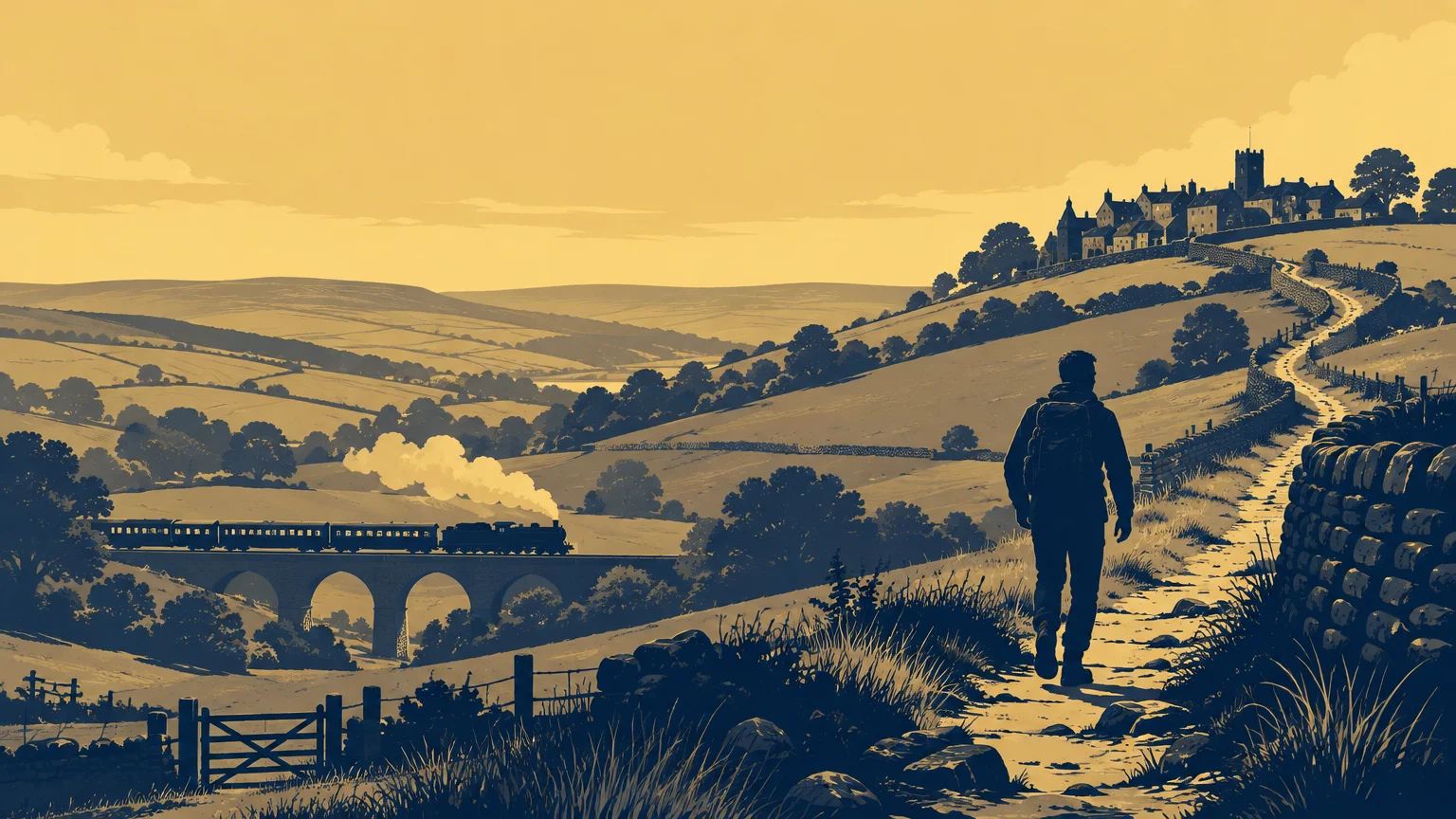
TLDR: The short walking route Oakworth to Haworth links the railway landscape around the two stations and is described by the Keighley & Worth Valley Railway as a little more than a mile and easy-going. Allow roughly 35–50 minutes for the station-to-station outing rather than treating it as a brisk pavement mile. Haworth Station is below the historic village, so reaching Main Street or the Brontë Parsonage means continuing uphill and allowing additional time. Do not confuse this short link with the separate 6½-mile Railway Children Walk.
The most important decision when planning the walking route Oakworth to Haworth is where you actually want to finish. Haworth Station, the foot of Main Street and the Brontë Parsonage are three different endpoints. A walk described simply as “to Haworth” can therefore be a modest railway-to-railway ramble or a longer outing with a pronounced final climb.
Oakworth to Haworth walk at a glance
| Option | Character | Distance and timing approach | Best for |
|---|---|---|---|
| Oakworth Station to Haworth Station | Short rural footpath linking two heritage railway locations | A little more than one mile; allow about 35–50 minutes as a cautious planning estimate | A compact walk, railway visitors and a possible train return |
| Oakworth Station to Haworth village centre | The short station link followed by an uphill extension | Longer than the official station link; leave a generous additional margin for the climb and stops | Visitors who want shops, cafés and historic Main Street |
| Oakworth Station to the Brontë Parsonage | Station link plus the climb through Haworth to the museum area | No precise total is supported by the supplied route evidence; plan it as a half-day visit rather than a simple one-mile walk | Literary-history visitors combining railway and Brontë interests |
| Railway Children Walk | A separate circular countryside route beginning and ending at Haworth Station car park | 6½ miles; this is not the short Oakworth–Haworth station link | Experienced walkers seeking a longer film-location outing |
The 35–50 minute allowance for the short link is a planning estimate, not a published official time. It builds in room for uneven ground, gates, photographs and finding the path. Conditions can make a short Pennine walk feel considerably longer than its mileage suggests.
What “Haworth” means on this walk
Haworth Station is the clearest endpoint for the short walk. It keeps the outing focused on the Worth Valley Railway and gives walkers an obvious place to pause before deciding whether to continue. It also makes a rail return possible on days when suitable services operate.
The station is not on Haworth’s famous Main Street. The Keighley & Worth Valley Railway describes the approach to the Brontë Parsonage Museum as a climb up the hillside Main Street, an important detail for anyone judging effort or timing. A visitor who has reached Haworth Station has arrived in Haworth, but not yet at the village’s best-known historic street or the Parsonage.
If your main interest is deciding how to divide time between railway heritage and the Brontë story, the comparison in Haworth for railway fans and literary visitors can help. The practical lesson is simple: choose your final destination before setting off, rather than adding the Main Street climb as an afterthought.
The short walking route from Oakworth to Haworth
The Keighley & Worth Valley Railway describes a Railway Children’s footpath from Oakworth to Haworth as “a little more than a mile” and “easy-going.” That description supports treating it as a short outing, but it should not be read as a promise of level paving, dry ground or step-free access.
The available official description does not establish every turn, gate or path junction. Rather than relying on an unverified turn-by-turn account, check the alignment on Bradford Council’s Map of Paths before departure. The council explains that this online map is a digitised working interpretation of public rights of way; the Definitive Map and Statement remain the legal record.
Carry an up-to-date map or downloaded route view and keep enough phone charge to consult it. At junctions, follow current waymarks and signs rather than assuming that the most obvious track is the public route. If a path is temporarily closed or diverted, obey the notices on site.
What the ground may feel like
“Easy-going” is best understood in local countryside terms. Expect a short valley walk rather than a surfaced urban promenade. Rain can soften field paths, wet vegetation can soak ordinary shoes, and gradients feel sharper when the ground is slippery. Stout walking shoes are the sensible default even when the weather in the village appears settled.
Current mud, livestock, vegetation, flooding, stiles and temporary diversions cannot be inferred from the route’s published length. Check recent conditions locally and be prepared to turn back if the path is obstructed or unsuitable for your party.
How hilly is the Oakworth to Haworth walk?
For most visitors, the decisive hill is not necessarily the short station link but the extension from Haworth Station into the historic village. Main Street rises conspicuously up the hillside. A walker comfortable with the first section may still want a pause before continuing towards the Parsonage.
Allow more time if you are walking with children, stopping for photographs or carrying a day bag. Haworth rewards an unhurried pace: stone shopfronts, railway views and changes in the valley landscape are part of the outing, not delays to be eliminated.
No supplied evidence supports describing the short footpath as wheelchair-accessible or pushchair-friendly. The railway’s explicit warning about suitability applies to the separate full Railway Children Walk, which it says is unsuitable for less-mobile walkers, wheelchair users and children in pushchairs. It also recommends stout footwear for South Pennine conditions. Anyone requiring step-free access should seek current, route-specific advice rather than transferring guidance from one walk to another.
Do not confuse it with the 6½-mile Railway Children Walk
Two similarly named outings create understandable confusion. The short Railway Children’s footpath runs between Oakworth and Haworth. The full Railway Children Walk is a 6½-mile circular route beginning and ending at Haworth Station car park. They differ in length, commitment and accessibility.
- Choose the station footpath if you want a short linear walk between Oakworth and Haworth.
- Choose the circular walk if you want a substantially longer countryside outing and have suitable footwear, time and mobility.
- Do not use the longer walk’s accessibility warning as a complete description of the short link—but do not assume the short link is accessible without checking it either.
- When reading a route description, confirm whether its stated start is Oakworth Station or Haworth Station car park.
For a wider itinerary combining the film connection, the stations and Haworth, see how to plan a Railway Children day trip to Oakworth and Haworth. That plan is useful when the walk is one part of the day rather than the sole objective.
A railway landscape with a film connection
Oakworth Station gives the walk much of its atmosphere. According to the heritage railway, the station opened on 15 April 1867, closed to passenger traffic on 1 January 1962 and reopened under preservation on 28 June 1968. The railway also identifies it with the 1970 film version of The Railway Children.
That history changes the character of the departure. The platforms, station buildings and valley setting are not merely a picturesque prelude to the footpath; they belong to the transport history that shaped movement through the Worth Valley. Why Oakworth Station still matters to the village explores that continuing local significance in more detail.
Treat the station as a working heritage railway environment. Remain in public areas, supervise children and follow staff instructions. If trains are operating, allow time to enjoy the station without letting photography distract you near platforms, roads or access points.
Walking one way and taking the train back
A one-way walk with a heritage-train return is an appealing way to experience the valley from two perspectives. Walk from Oakworth to Haworth, explore around the station, then return by rail if the day’s timetable and ticket arrangements allow. The reverse plan can work too, although finishing at Oakworth leaves you away from Haworth’s Main Street attractions.
Heritage services do not necessarily run like an everyday urban timetable. Check the live Keighley & Worth Valley Railway schedule before travelling, note the final suitable departure and leave a margin for the walk. Have a fallback plan in case your chosen service is unavailable.
Extending the walk into Brontë country
Once you have climbed into Haworth, the route can become the beginning of a longer literary landscape walk. The Brontë Parsonage Museum provides a downloadable Haworth footpaths map and highlights onward destinations including the Brontë Waterfall, Top Withens and Ponden Kirk. Consult the Brontë Parsonage Museum’s maps and walks resources before choosing an extension.
These are not casual add-ons to a short station stroll. Moorland weather, daylight, navigation and footwear become more important as the distance grows. Bradford Council also publishes self-guided walking material covering Haworth, Stanbury and the Worth Valley, providing another official starting point for a longer day.
A practical pre-walk checklist
- Decide whether your endpoint is Haworth Station, Main Street or the Brontë Parsonage.
- Check Bradford Council’s path mapping and any current closure or diversion notices.
- Check the weather and recent ground conditions; take footwear suitable for wet field paths.
- Download the route information before leaving in case mobile reception is inconsistent.
- Carry water and a light waterproof layer, even for the short option.
- If returning by train, verify the live timetable, ticket requirements and final useful service.
- Allow extra time for the uphill continuation from Haworth Station.
- Keep dogs under close control, particularly around livestock, and follow signs on the ground.
- Turn back if conditions, access furniture or gradients are unsuitable for anyone in your group.
The best way to plan your outing
For the simplest version, walk from Oakworth Station to Haworth Station and allow 35–50 minutes without rushing. For a fuller village visit, continue uphill but treat Main Street and the Brontë Parsonage as a deliberate extension. For a substantial countryside day, choose the separate 6½-mile Railway Children Walk or a mapped Brontë-country route instead.
Before setting out, check the right-of-way map, current path conditions and railway timetable. Once those practical points are settled, the walk can be enjoyed for what it does particularly well: joining two handsome railway places while revealing how the stone villages sit within the folds and slopes of the Worth Valley.