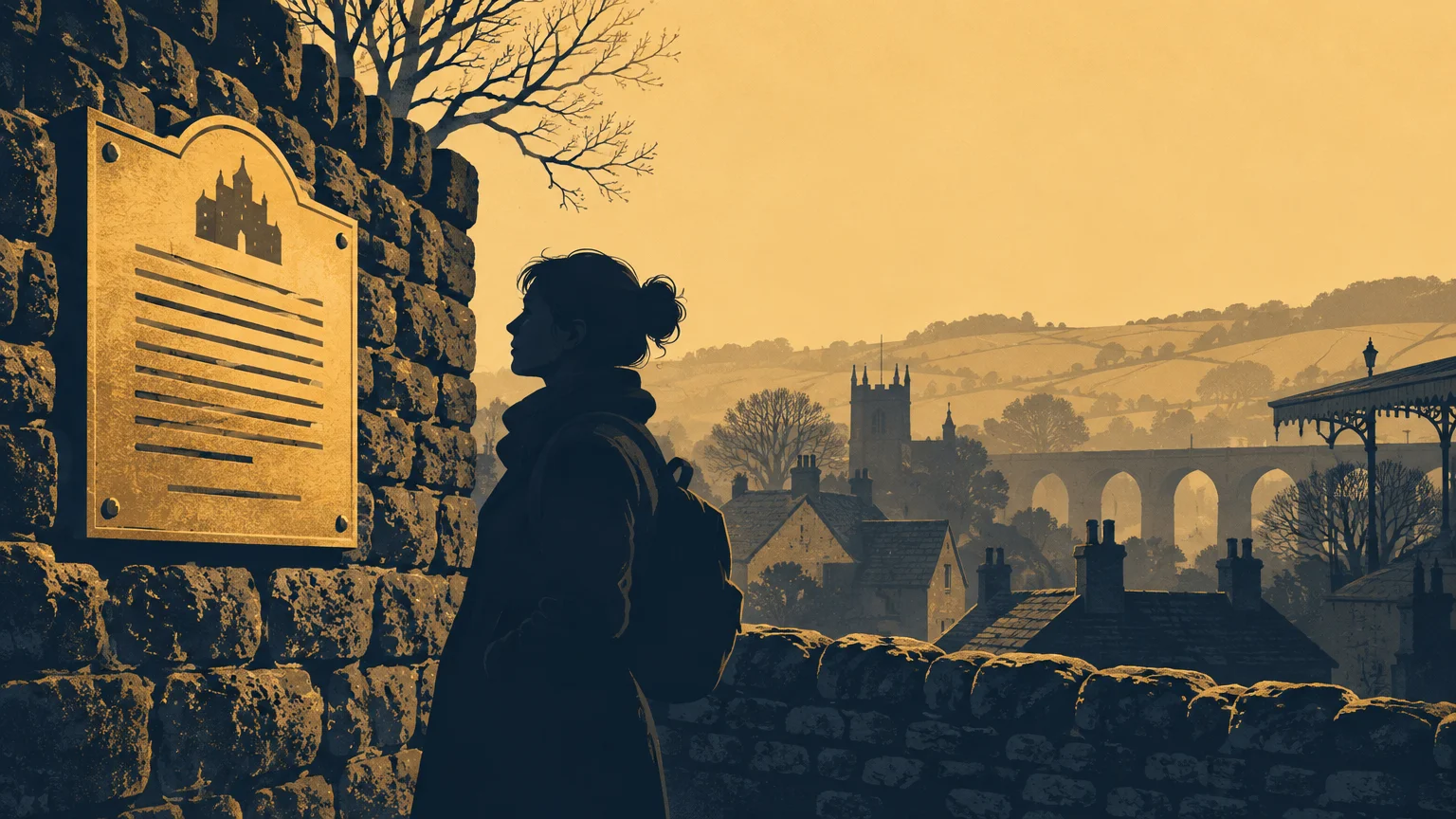
A good historic-site plaque does not attempt to tell the whole story. It identifies the subject, explains why it matters and makes its connection to that precise place clear. Everything else—long chronology, quotations, maps, memories and disputed details—belongs in another layer of interpretation.
That discipline can feel rather brutal when a committee has spent months uncovering a century of village history. Yet a plaque read from the pavement has a different job from an archive file. The writing succeeds when a passer-by can understand it in a few moments and leaves knowing why an otherwise quiet building, gateway or patch of ground deserves attention.
Decide whether the story really belongs on a plaque
Begin by asking what is being commemorated and why the plaque must stand at this particular location. It may mark a person’s home, the founding place of an organisation, the surviving premises of a business or the site of an event. The geographical connection should be direct enough to express in one unambiguous sentence.
The English Heritage guidance on commemorative plaques identifies the essential ingredients as the subject’s name, relevant dates, a concise explanation of significance and the precise association between subject and location. It also stresses that wording should be historically correct because an inscription can influence public understanding of a building for many years. If the original building has disappeared, the plaque should say that it marks the site rather than implying that the surviving structure is original.
Some stories simply will not fit. A building that has served as a farmhouse, school, workshop and meeting room may need interpretation rather than commemoration. The National Lottery Heritage Fund distinguishes short object labels of about 60 words at most from larger, roughly 100-word top-level panels, while recommending one overarching theme supported by three to five messages. These are useful planning benchmarks rather than laws for every local scheme. Its interpretation guidance can help a group decide what visitors should understand first.
| Choose this format | When it works best | What it should contain |
|---|---|---|
| Commemorative plaque | One verified person, event or association tied closely to one place | Identity, dates, significance and exact connection to the location |
| Interpretation panel | A layered site, longer sequence of events or several related subjects | A clear theme, selected facts, images, map or short chronology |
| QR-linked page | Sources, oral histories, accessible formats, updates or multiple viewpoints | The fuller account, evidence and material that cannot fit comfortably on the sign |
Research the location before polishing the prose
Plaque writing begins with evidence, not adjectives. Build a small research file containing the strongest source for every proposed name, date, occupation, event and claim of importance. Deeds, directories, census records, newspapers, railway records, historic maps, photographs and meeting minutes can each answer different questions. For an Oakworth property, the methods in our guide to researching the history of a house or street provide a sensible route from present-day evidence into older records.
Give particular attention to the relationship between the subject and the address. “Lived here,” “worked here,” “was founded here” and “stood on this site” are not interchangeable. Nor should a plaque quietly turn a local tradition into a documented fact. English Heritage advises omitting doubtful claims or delaying installation while research continues rather than relying upon phrases such as “might have” or “in this vicinity.”
Oakworth’s railway history offers a useful warning. Current Keighley & Worth Valley Railway pages give different dates for the restoration of passenger trains: the general history gives 29 June 1968, while the Oakworth Station page gives 28 June. A temporary article can acknowledge that discrepancy; an inscription intended to remain for decades should resolve it from archival or contemporary evidence before manufacture.
Find the one sentence that carries the story
Before drafting the inscription, complete this sentence: “This place matters because…” The answer is the plaque’s governing idea. If the answer contains three unrelated uses of “and,” the subject is probably too broad.
Significance should be specific rather than ceremonial. “An important local figure” tells the reader almost nothing. “Organised the village’s first lending library in these rooms” explains both the achievement and its relationship to the site. Likewise, “played a role in railway history” is weaker than a carefully verified account of what happened there.
Local importance is enough when the scheme is intended to record local heritage. English Heritage’s London blue-plaque criteria belong to that particular scheme; local and regional programmes may establish their own standards of significance. Set those standards before assessing nominations so that enthusiasm, fame and personal connections do not become substitutes for evidence.
Draft long, then cut in the right order
Write an initial version without worrying about the final line count. Then reduce it in deliberate passes:
- Underline the subject, dates, significance and relationship to the place. These are the protected facts.
- Remove background that does not help readers understand why this location is marked.
- Replace institutional language with direct verbs. “Opened a workshop here” is shorter and clearer than “was responsible for the establishment of.”
- Delete praise that the evidence does not demonstrate, including “famous,” “pioneering” and “beloved.”
- Read the result aloud, then test it at the intended viewing distance and in the proposed line arrangement.
A working structure might read: “NAME (dates), occupation or role, lived/worked/founded something HERE from date to date. One short sentence explaining the achievement or local significance.” This is a framework, not a command to force every subject into identical grammar. Sometimes the event deserves the first line; sometimes the building does.
Do not sacrifice the crucial location word during cutting. A plaque saying that an organisation “was founded in 1902” leaves the reader wondering whether it was founded in the marked building, elsewhere in the village or merely during that year. “Founded in this building in 1902” answers the question the plaque exists to settle.
Write for a person standing outside
Plaques are physical objects, and prose that looks neat in a document may fail on stone or enamel. Line length, punctuation, letter size, upper- and lower-case text, mounting height and viewing distance all affect legibility. English Heritage notes that all-capital lettering can be harder to read.
Print the proposed inscription at scale if possible. Ask several people who were not involved in the research to read it briefly. Can they identify who or what is commemorated? Can they explain why the place matters? Did a line break separate a date from the event it qualifies? Local testing is especially valuable because project members already know the story and unconsciously fill in missing information.
Plain language need not drain away character. A well-chosen concrete detail—a trade practised in the building, the former purpose of a room or the destination of a railway service—often conveys more atmosphere than a row of reverent adjectives. The aim is not to make history sound grand. It is to make the significant detail visible.
Give complicated histories enough room
A short plaque is poorly suited to contested interpretations, changing terminology or histories that require several perspectives. Compressing those subjects can create a misleading certainty. Government guidance on contested commemorative heritage supports contextual interpretation, with digital material among the ways to provide fuller evidence and different perspectives. It also identifies consultation and audience testing as relevant considerations.
A plaque can therefore serve as the doorway rather than the entire room. A linked page can hold sources, maps, transcripts, oral histories, translations and updates. If that approach suits the project, plan the digital destination as carefully as the inscription; our guide to using QR code stickers for heritage walking trails covers the practical interpretation layer. The physical text should still make sense when a visitor has no phone, signal or desire to scan.
Check consent before ordering anything
Agreement about the words is not permission to drill into a wall. Establish who owns the building, who will fund the plaque, who will maintain it and who can authorise installation. English Heritage identifies owner agreement and a sponsoring or funding body as practical considerations for a permanent marker.
Extra care is required for a listed building. Historic England’s listed building consent guidance advises discussing proposed work with the local planning authority before it begins and warns that unauthorised work affecting a listed building can be a criminal offence. Bradford’s Oakworth conservation material likewise says consent is required for work affecting a listed building’s special character or appearance. It notes that unsuitable signage and alterations can harm the conservation area, making scale, material, siting and fixing method part of the heritage decision rather than an afterthought.
Use a final inscription check
- Is every name, date and factual claim supported by a reliable source?
- Does the wording state exactly how the subject is connected to this location?
- If the original building is gone, does the inscription clearly say “site of” or equivalent?
- Can a new reader identify the main significance without prior local knowledge?
- Have uncertain traditions been omitted rather than disguised with vague wording?
- Is the text legible at the likely distance, height and lighting conditions?
- Would a panel or linked interpretation page serve any omitted material better?
- Have the owner, planning authority and other relevant bodies approved the installation where required?
- Is there a record of the final wording, sources, permissions and maintenance responsibility?
The best short plaque leaves something out without leaving the reader short-changed. Protect the verified association, choose one clear reason the place matters and let every remaining word serve those two things. Once the draft passes that test, place it at the proposed site, step back to pavement distance and read it as a stranger would. That modest act catches more problems than another hour spent admiring it around a committee table.
References
- Celebrating People and Place: Guidance on Commemorative Plaques & Plaque Schemes
- Interpretation good practice guidance | The National Lottery Heritage Fund
- Our History – Keighley & Worth Valley Railway
- Oakworth Station – Keighley & Worth Valley Railway
- Celebrating People and Place: Guidance on Commemorative Plaques & Plaque Schemes
- Propose a plaque | English Heritage
- Guidance for custodians on how to deal with commemorative heritage assets that have become contested – GOV.UK
- Listed Building Consent | Historic England
- Oakworth Conservation Appraisal