
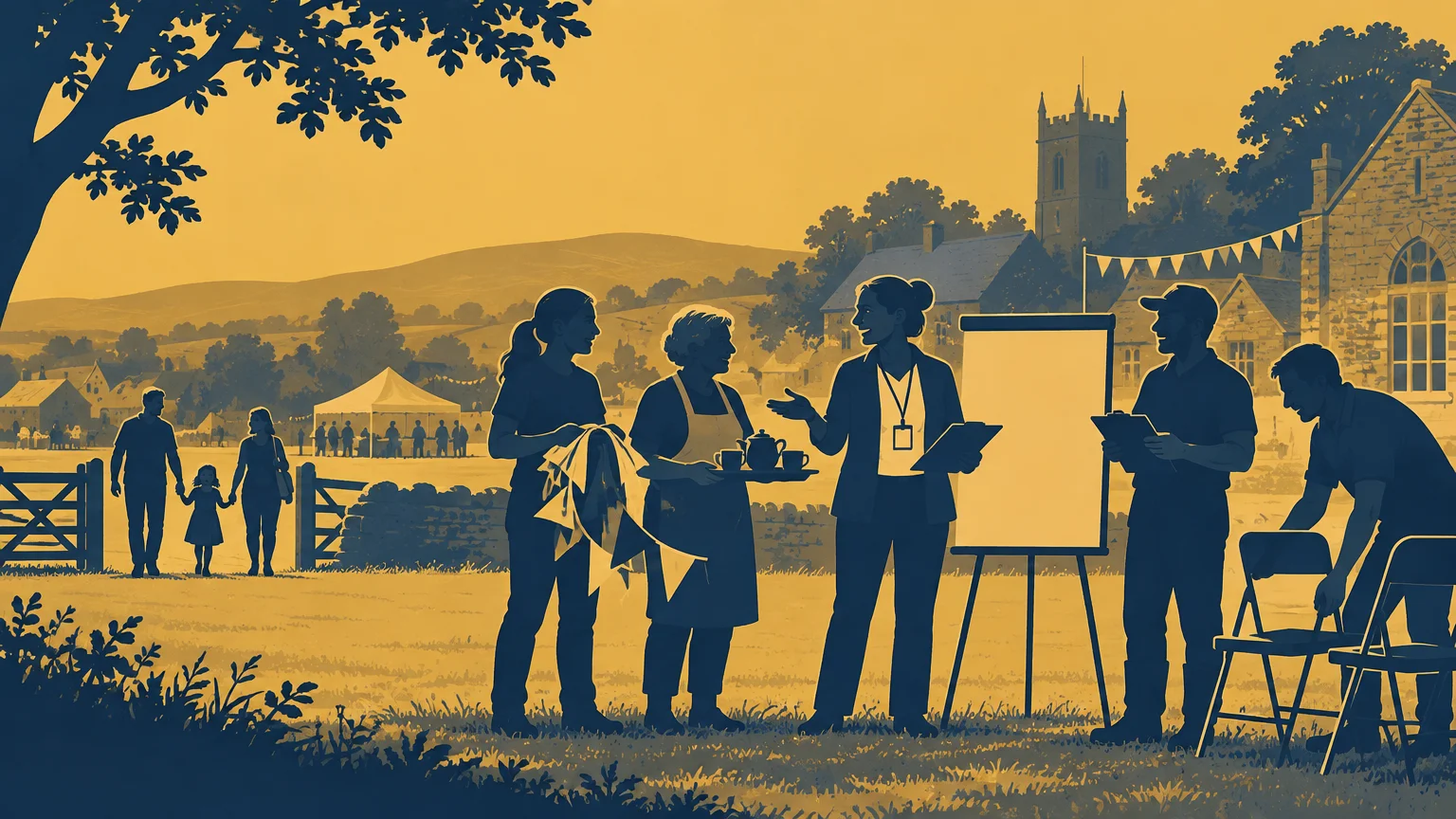
Successful village event volunteer recruitment begins with jobs, not numbers. Instead of asking for “as many helpers as possible,” list the work, divide it into manageable shifts and tell people precisely what each role involves. A resident who cannot surrender an entire Saturday may still welcome visitors for 90 minutes, sell programmes for an hour or help clear the field at dusk.
Make the first invitations personal and early. Ask previous helpers, neighbours and community contacts to take one specific role, then publish a wider appeal for the remaining gaps. This combination gives the rota an initial backbone without leaving the whole event on the shoulders of the familiar few.
Build the rota before recruiting volunteers
Begin with the event programme and work backwards. Walk through the day from the arrival of the first delivery to the removal of the last sign. Include setup, public-facing work, breaks, cover for absences and pack-down. The official GOV.UK guide to voluntary and community events similarly recommends clarifying an event’s purpose and scale, sharing the work, considering permissions and safety, planning event-day arrangements and completing the tasks that remain afterwards.
There is no universal volunteer number. A compact indoor exhibition needs a different team from a gala with a procession, refreshments and activities spread across a field. Count positions instead: if six posts must be covered during each of three time periods, that creates 18 shift slots. One person may fill more than one slot, but build in breaks and avoid making the plan depend on everyone staying longer than promised.
| Example role | Useful shift length | Briefing needed | Physical or access notes | Good fit for |
|---|---|---|---|---|
| Setup and signs | 1–2 hours before opening | Site plan, lifting method and restricted areas | State any lifting, walking or uneven-ground requirements | People who prefer practical work away from crowds |
| Welcome point | 1–2 hours | Programme, site layout, contacts and lost-child procedure | Provide a seat or rotate standing duties where possible | Friendly first-time helpers with local knowledge |
| Programme or raffle sales | 1–2 hours | Prices, cash or payment procedure and escalation contact | Offer a seated position and secure place for materials | Confident communicators working in pairs |
| Route or area steward | 1–2 hours | Boundaries, emergency procedure and who makes decisions | Disclose distance, weather exposure and terrain | People comfortable giving clear directions |
| Refreshment support | 1–2 hours | Hygiene arrangements, menu, allergens process and equipment rules | Identify heat, carrying and prolonged-standing requirements | Helpers assigned only to tasks covered by the briefing |
| Tidy-up and pack-down | 1–2 hours after closing | Waste plan, storage points and safe lifting | Specify lifting and outdoor work honestly | Later arrivals and practical volunteers |
Separate ordinary hospitality from roles carrying greater responsibility. Directing road traffic, operating machinery, supervising children, handling substantial cash or making safety decisions should not be slipped into a general “steward” description. Define the competence, supervision and authority required before advertising such work.
Use a six-week recruitment sequence
- Six weeks before: confirm the programme, list every job and assign a named lead for each area.
- Five weeks before: approach previous helpers and personal contacts with specific roles and times.
- Four weeks before: publish the wider call through relevant community groups, clubs, parent networks, local businesses, noticeboards and social channels. Ask permission before posting and do not imply that a group endorses the event.
- Three weeks before: review the rota, identify uncovered or fragile shifts and make targeted requests based on the work still needed.
- One to two weeks before: confirm each volunteer’s role, precise hours, meeting point, accessibility needs, clothing or equipment, named contact and briefing arrangements.
- During the final week: issue the concise event plan, check withdrawals and hold a briefing for team leads and higher-responsibility roles.
For a smaller gathering, this sequence can be compressed, but keep the order. Publishing a broad appeal before defining the work usually creates a muddle of kind offers with no clear way to use them.
Write a volunteer advert people can answer
A useful advert removes uncertainty. Give the event name and purpose, date, exact shift times, location, task, reporting contact, briefing arrangements and sign-up method. Say whether the role involves standing, lifting, outdoor work, cash handling or contact with children. Include what is provided and what the volunteer should bring.
A role card might read: “Welcome volunteer, 12.30–2.30pm. Meet the welcome lead at the main entrance at 12.20pm for a ten-minute briefing. Give visitors programmes, point out facilities and refer access questions to the event lead. A chair is available. Outdoor clothing may be needed. Reply by email with your name, telephone number and any access requirements.”
Use the same wording in the advert, rota and briefing sheet so the role does not quietly expand. Printed copies can be useful where phone reception is unreliable or volunteers need a quick reference at a busy gate. If the project needs signs, role cards or rota sheets, compare suitable printed volunteer materials alongside what can be produced economically at home. For visible identification at a gala, the existing guide to volunteer stickers and badges covers a related practical choice.
Make first-time helpers feel useful, not tested
New volunteers are more likely to step forward when the commitment is transparent and they know support will be available. Pair newcomers with an experienced person, give them a named contact and avoid unexplained local shorthand. A visitor who knows the railway or walking landscape may have useful knowledge, but should still receive the same event-specific briefing as a resident.
The Keighley & Worth Valley Railway offers a helpful local illustration of this principle, while operating on a much larger and more specialised scale. It says most new volunteers arrive without railway experience and learn alongside established volunteers. It also distinguishes between occasional help and safety-critical roles carrying competence and commitment requirements. A one-day village event should not copy railway operations, but it can adopt the sound habits of clear expectations, mentoring and role-appropriate training.
Brief for safety, accessibility and safeguarding
Nominate an event safety lead and ensure volunteers know who that person is. Bradford Council’s event guidance says organisers should appoint a health-and-safety lead and brief staff and volunteers on the safety plan and risk assessment. HSE guidance also says volunteers should be included in the risk assessment, with the approach reflecting the actual risks of their work.
The event-day briefing should cover the site layout, emergency arrangements, first-aid contact, incident reporting, weather plan, restricted areas and the limit of each volunteer’s authority. Add role-specific information rather than burying everyone beneath details they cannot use. Ask about reasonable access needs privately and early enough to adjust a task, meeting point or shift.
Safeguarding measures must match the activity and the people involved. Where children or adults at risk are concerned, organisers should establish appropriate policies, supervision, training and a designated lead. DBS decisions should be based on the role and applicable requirements; a check is not an automatic condition for every person handing out programmes or arranging chairs. GOV.UK’s safeguarding guidance stresses a proportionate approach based on the work and risks involved. Under-18 volunteers also require an arrangement set by the host organisation, including suitable consent and supervision where applicable.
Keep volunteers after the bunting comes down
Recruitment for the next event begins with how people are treated at this one. Start and finish shifts when promised, provide breaks, check that volunteers have what they need and thank the pack-down team as warmly as the people who welcomed the first visitors. A short message afterwards can report what happened, invite practical feedback and ask whether the person wishes to hear about another event.
Keep simple notes on which roles were difficult to fill, where queues developed and which instructions caused confusion. Do not assume that willing helpers should return indefinitely. Rotate responsibilities, create short entry-level shifts and invite newer people to shadow team leads. That is how a village widens its circle rather than repeatedly calling upon the same dependable handful.
The practical next step
Before writing a public appeal, list the first eight to twelve jobs your event cannot run without. Give each one a start time, finish time, meeting place, named lead and honest description. Split long duties into short shifts, then personally invite people to the clearest roles. Once those first names are on the rota, publish the remaining vacancies—not as a plea for anonymous help, but as a welcoming set of useful jobs that someone can confidently say yes to.
Frequently Asked Questions
How many volunteers does a village event need?
There is no universal number. List every position that must be covered during each time period, then count the resulting shift slots. Allow for breaks and avoid relying on volunteers staying beyond their agreed finish times.
How far in advance should organisers start recruiting volunteers?
A six-week sequence gives time to define roles, approach previous helpers and personal contacts, publish a wider appeal, fill gaps, confirm arrangements and brief the team. Smaller events can compress the timetable while keeping the same order.
What should a volunteer advert include?
State the event’s purpose, date, location, exact shift times, task, reporting contact, briefing arrangements and sign-up method. Clearly mention standing, lifting, outdoor work, cash handling or contact with children, along with what is provided and what volunteers should bring.
Which roles are suitable for first-time volunteers?
Clearly bounded roles such as welcoming visitors, distributing programmes or helping with setup can suit newcomers. Pair first-time helpers with an experienced person, provide a named contact and give everyone the same event-specific briefing.
What should an event-day volunteer briefing cover?
Cover the site layout, emergency arrangements, first-aid contact, incident reporting, weather plan, restricted areas and each volunteer’s authority. Organisers should nominate a safety lead, brief volunteers on the safety plan and include their work in the risk assessment.
Does every event volunteer need a DBS check?
No. Safeguarding arrangements and DBS decisions should be proportionate to the role, activity and risks involved. Work involving children or adults at risk may require suitable policies, supervision, training and a designated lead, but a check is not automatic for every general helper.