
TLDR
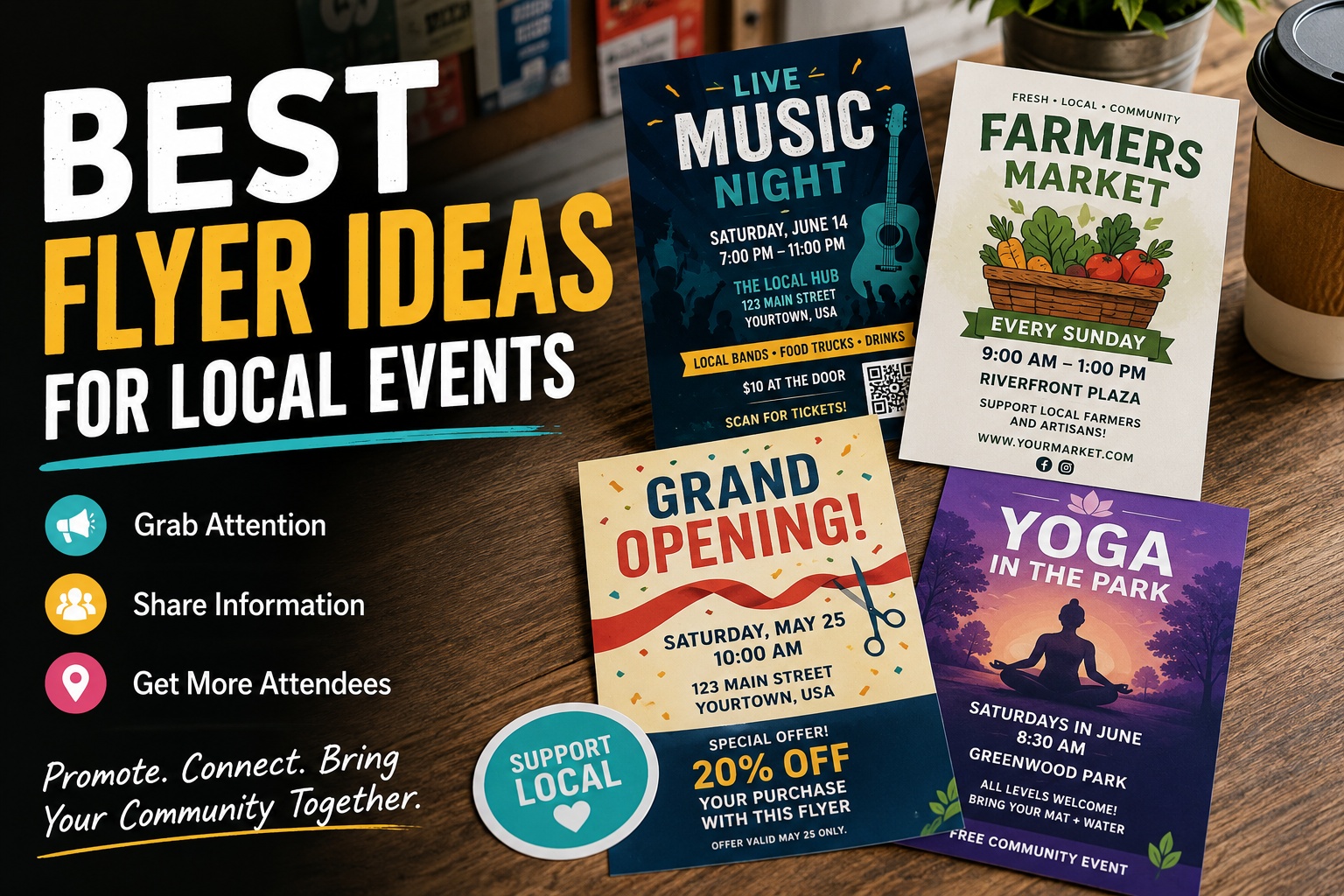
The best flyer ideas for local events are clear, specific, and easy to act on. A good event flyer should show what the event is, when it happens, where it happens, who it is for, and what someone should do next. Strong local flyers often use bold headlines, simple layouts, QR codes, maps, coupon offers, tear-off tabs, stickers, and designs that feel connected to the neighborhood.
A flyer has a very small job: get someone to stop, understand, and care.
That is why the best flyer ideas for local events are not always the flashiest. A flyer for a school fundraiser, farmers market, open house, concert, pop-up shop, or community workshop needs to work fast. People may see it on a coffee shop board, in a storefront window, inside a takeout bag, on a counter, or in a stack at another local business.
If the flyer is too crowded, too vague, or too hard to read, it gets ignored. If it feels useful and easy to scan, it has a better chance of bringing people through the door.
Start With One Clear Event Message
Before choosing colors, photos, or graphics, decide the one thing the flyer needs to say.
A local event flyer should not try to explain your entire business. It should promote one event or one action. That could be “come to the grand opening,” “visit the holiday market,” “join the fundraiser,” “book a spot,” or “bring this flyer for a discount.”
A simple flyer message usually includes:
- Event name
- Date and time
- Location
- Short reason to attend
- Cost or free entry note
- Website, phone number, or QR code
- Clear call to action
For example, a strong headline might be:
“Spring Makers Market This Saturday”
That is much clearer than:
“Join Us for a Special Community Shopping Experience”
The first one tells people what is happening and when. The second one sounds nice, but it makes the reader work harder.
Use a Bold Local Hook
Local flyers work best when they feel tied to the place where they appear.
A flyer for a neighborhood event should not sound like a generic ad that could run anywhere. Use the town name, neighborhood name, school name, venue name, season, local landmark, or community group when it helps.
Examples:
- “Downtown Summer Art Walk”
- “Westside Food Truck Night”
- “Back-to-School Bash at Lincoln Elementary”
- “Saturday Pop-Up at Main Street Market”
- “Local Vendor Night at Oak & Pine Brewery”
- “Northside Pet Adoption Day”
This kind of wording gives the flyer context. It also helps people quickly decide whether the event is close enough, relevant enough, or familiar enough to consider.
The best flyer ideas for local events usually make the location part of the appeal.
Pick the Right Flyer Format
Not every local event needs a full-page flyer. The format should match how the flyer will be used.
Here is a simple way to choose:
| Flyer Type | Best For | Why It Works |
|---|---|---|
| 4×6 flyer | Counters, bag inserts, handouts | Small, easy to distribute, quick to read |
| 5×7 flyer | Pop-ups, workshops, local promos | More room without feeling oversized |
| Half-page flyer | Community boards, school events, markets | Good balance of detail and visibility |
| 8.5×11 flyer | Windows, bulletin boards, larger events | Easy to notice from a distance |
| Tear-off flyer | Services, classes, sign-ups | Gives people something to take |
| Coupon flyer | Retail events, restaurants, salons | Adds a reason to act soon |
| QR code flyer | Ticketed events, RSVPs, online details | Keeps the printed design cleaner |
For printed handouts, custom flyers work well because they give you more room than a business card or sticker while still being easy to pass out, post, or include with customer orders.
The main mistake is choosing a format before deciding where the flyer will go. A flyer taped in a window needs bigger text than one handed directly to a customer.
Try a “What, When, Where” Layout
One of the most reliable flyer layouts is also the simplest.
Put the event name at the top. Put the date and time directly under it. Put the location next. Then add one short description, one visual, and one call to action.
A clean order could look like this:
Headline:
Holiday Craft Market
Date and Time:
Saturday, December 7, 10 AM to 4 PM
Location:
Main Street Community Hall
Short Details:
Local makers, gifts, food vendors, kids’ activities, and free entry.
Call to Action:
Scan to see vendors and RSVP.
This format is not fancy, but it works. People should not have to search for the basics.
Use QR Codes Without Letting Them Take Over
QR codes are useful on local event flyers, especially when the event has tickets, RSVP forms, vendor lists, menus, maps, or schedule details online.
But the flyer should still make sense without the QR code.
Do not use a QR code as a replacement for basic information. Use it as the next step.
Good QR code uses include:
- RSVP page
- Ticket page
- Vendor list
- Full event schedule
- Google Maps location
- Menu or product preview
- Discount code page
- Social media event page
- Volunteer sign-up form
Add a short line of text near the code so people know why they should scan it.
For example:
“Scan for the full vendor list.”
That is better than placing a random QR code in the corner with no explanation.
Create a Coupon Flyer
Coupon flyers are strong for local events because they give people a reason to keep the flyer.
This works well for:
- Restaurants
- Coffee shops
- Salons
- Gyms
- Boutiques
- Car washes
- Bakeries
- Pet shops
- Local service businesses
- Pop-up shops
The offer does not need to be huge. It just needs to be clear.
Examples:
- “Bring this flyer for 10% off your first class.”
- “Show this flyer for a free drink with purchase.”
- “Bring a friend and both get $5 off.”
- “Use code MARKET10 when you visit our booth.”
- “Scan to claim the event-only offer.”
A coupon flyer should have a clean expiration date. If there are rules, keep them short. Fine print can make a small flyer feel crowded fast.
Make a Flyer That Doubles as a Mini Poster
Some local event flyers are meant to be picked up. Others are meant to be seen from a few feet away.
For windows, community boards, school hallways, venue walls, and bulletin boards, design the flyer like a mini poster. Use fewer words, larger type, and stronger contrast.
A good mini-poster flyer should be readable at a glance.
Use this structure:
- Big event name
- Large date
- Simple visual
- Location
- QR code or short URL
- One sentence of context
For example:
“Live Music Friday”
Then under it:
“June 14 at 7 PM”
Then:
“Free entry. Local bands, food trucks, and outdoor seating.”
This type of flyer is good for concerts, open houses, markets, classes, fundraisers, and community nights.
Add Stickers as a Takeaway
A flyer tells people about the event. A sticker can help them remember it.
For local events with a strong visual identity, add a small branded sticker, logo sticker, or event sticker as a handout. This is especially useful for school events, music events, maker markets, grand openings, nonprofits, races, clubs, and community groups.
You could pair a flyer with:
- A logo sticker
- A mascot sticker
- A limited event sticker
- A QR code sticker
- A “support local” sticker
- A vendor sticker pack
- A kids’ activity sticker
This gives people something more permanent than a paper handout. A flyer may get tossed after the event. A good sticker can end up on a laptop, notebook, water bottle, cooler, or register drawer.
For events that need a small branded giveaway, branded stickers can work as an easy add-on to flyer campaigns.
Use Tear-Off Tabs for Classes and Services
Tear-off flyers still work in the right setting.
They are useful when the event requires a call, text, email, or sign-up. Think music lessons, tutoring, fitness classes, repair services, babysitting, workshops, pet sitting, art classes, cleaning services, and neighborhood groups.
A tear-off tab should include only the most useful detail:
- Phone number
- Short URL
- QR code
- Discount code
- Class name
- Event date
Keep the main flyer clean. The tear-off tabs should not be the only place where contact information appears.
This style works best on community boards, campus boards, coffee shops, libraries, gyms, and local stores that allow flyers.
Make a Map Flyer for Events That Are Hard to Find
If your event location is confusing, make the map part of the flyer.
This is helpful for:
- Farmers markets
- Outdoor festivals
- School campuses
- Multi-building venues
- Parking-limited events
- Warehouse sales
- Large church events
- Parks and recreation events
- Pop-up shops inside other businesses
Do not overdo the map. A simple landmark-based map is often better than a detailed street map.
Use labels like:
- Free parking
- Main entrance
- Vendor check-in
- Food trucks
- Stage
- Restrooms
- Kids’ area
- Pickup area
For local events, removing confusion can directly improve attendance. If people are unsure where to park or enter, some will simply skip it.
Design a Flyer Around the Audience
A flyer for parents should not look like a flyer for a nightclub. A flyer for a business workshop should not look like a flyer for a skate contest.
Match the design to the people you want to reach.
For family events, use clear dates, friendly colors, simple language, and practical details like parking, food, cost, and age range.
For music or nightlife events, focus on mood, performers, venue, time, age rules, and ticket link.
For business events, keep the design clean and make the benefit clear.
For charity events, explain the cause and where the money or support goes.
For retail events, make the offer easy to understand.
For school events, make the flyer parent-friendly. Include the date, time, pickup details, cost, and contact person.
This is where many event flyers go wrong. They look good to the organizer, but they do not answer the attendee’s real questions.
Create a Flyer and Sticker Sheet Combo
For events with vendors, sponsors, clubs, or multiple activities, a flyer and sticker sheet combo can make the promotion feel more interactive.
The flyer gives the details. The sticker sheet gives people something fun to keep.
This idea works well for:
- School fairs
- Summer camps
- Craft fairs
- Food festivals
- Kids’ events
- Art markets
- Bookstore events
- Community fundraisers
- Brand pop-ups
A sticker sheet could include small icons for vendors, event mascots, sponsor logos, local landmarks, or themed illustrations.
Here is a simple product page for that kind of add-on: https://customstickers.com/products/sticker-sheets
This is not necessary for every event. But when the event has a strong visual theme, it can make the whole promotion feel more memorable.
Place Flyers Where People Already Make Local Plans
A flyer only works if the right people see it.
For local events, think about where your audience already goes. A flyer for a kids’ event may belong in schools, libraries, pediatric offices, dance studios, toy stores, and coffee shops. A flyer for a concert may belong in record stores, bars, music shops, cafes, colleges, and venue windows.
Good local flyer locations include:
- Coffee shops
- Libraries
- Community centers
- Gyms
- Schools
- Campus boards
- Local restaurants
- Retail counters
- Apartment mailrooms
- Church bulletin boards
- Visitor centers
- Coworking spaces
- Salons and barbershops
- Farmers market booths
- Partner businesses
Always ask before posting flyers. A friendly relationship with local businesses is worth more than sneaking a flyer onto a board where it does not belong.
Keep the Copy Short
Most flyers have too many words.
A local event flyer should not feel like a full article. Use short copy and make each line earn its space.
Instead of:
“Join us for an exciting afternoon featuring a variety of local vendors, family-friendly activities, delicious food options, and special community experiences.”
Try:
“Local vendors, food trucks, kids’ activities, and free entry.”
That is faster. It is also easier to scan from a bulletin board.
A good flyer often needs fewer details than the organizer thinks. Put the full schedule, vendor list, parking details, and extra information online. Then use the flyer to send people there.
Add Social Proof When It Helps
If the event has happened before, a small proof point can help.
Examples:
- “Over 40 local vendors”
- “Back for our 5th year”
- “Hosted by the Downtown Business Association”
- “Family-friendly and free to attend”
- “Featuring local artists, food trucks, and live music”
Keep it specific. Avoid vague phrases like “an amazing event” or “the best night of the year.” Those lines do not tell people much.
If you have room, a strong photo from last year’s event can also help. Just make sure the photo prints clearly and does not make the text hard to read.
Use a Simple Pre-Print Checklist
Before ordering flyers, check the basics. This is not the exciting part, but it prevents avoidable mistakes.
Use this checklist:
- Is the event name clear?
- Is the date correct?
- Is the time correct?
- Is the address complete?
- Is the cost or free entry note included?
- Is the call to action obvious?
- Does the QR code work?
- Does the flyer still make sense without scanning the QR code?
- Is the text readable at the final size?
- Are sponsor logos clear and not stretched?
- Are social handles and URLs spelled correctly?
- Is there enough contrast between text and background?
- Did someone else proofread it?
For local events, one wrong date or address can create a lot of frustration. Proofreading is boring until it saves the whole campaign.
Conclusion
The best flyer ideas for local events are practical first. They make the event easy to understand, easy to find, and easy to remember.
Start with one clear message. Choose the flyer size based on where it will be used. Make the date, time, and location impossible to miss. Add a QR code only if it supports a clear next step. Use coupons, maps, tear-off tabs, stickers, or flyer-and-sticker combos when they make the flyer more useful.
A good flyer does not need to say everything. It needs to say the right thing clearly enough that someone takes action.
That might mean showing up Saturday, scanning for tickets, saving the date, sharing the event with a friend, or bringing the flyer in for an offer.
Simple usually wins.