
TLDR
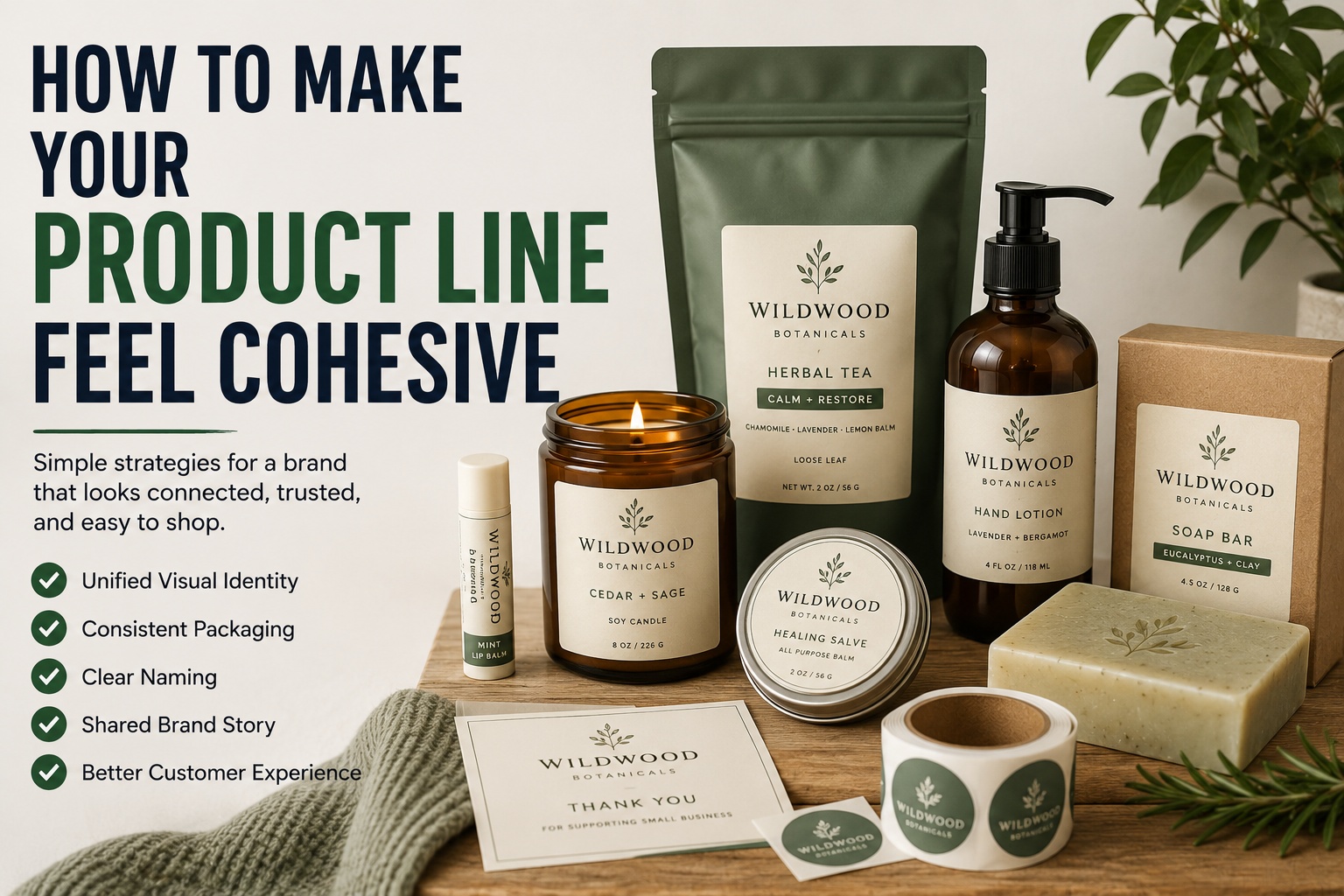
A cohesive product line feels like every item belongs to the same brand, even if the products are different. Start with a clear customer, a shared visual identity, consistent naming, related packaging, and a simple product structure. You do not need every item to look identical. You need enough consistency that customers understand the collection quickly and trust what they are buying.
A product line can have variety without feeling random.
That is the balance. If every product looks exactly the same, customers may struggle to tell items apart. But if every product looks unrelated, the brand feels scattered. A cohesive product line gives shoppers a sense of order. They can see what each product does, how the items connect, and why they all belong under the same brand.
For small businesses, artists, makers, food brands, skincare brands, candle companies, apparel brands, and sticker shops, cohesion can make a product line easier to browse and easier to buy. It also makes your booth, website, packaging, and social posts look more polished without needing a huge catalog.
Start With the Customer and Use Case
Before fixing colors or labels, ask who the product line is for and how the products fit into that person’s life.
A cohesive product line usually has a clear point of view. It does not need to serve everyone. In fact, trying to serve everyone is often what makes a product line feel messy.
Ask:
- Who is this product line for?
- What problem, need, or interest connects the products?
- Are the items used together, collected together, gifted together, or compared against each other?
- What should customers understand within five seconds?
- What should they feel confident buying first?
For example, a candle brand might build a line around cozy seasonal scents, clean home fragrance, or colorful giftable candles. Those are different product directions. Each one would lead to different labels, names, photography, and packaging.
A sticker artist might build a product line around outdoor adventure, cozy animals, gaming jokes, or small business packaging extras. The products could include die cut stickers, sticker sheets, magnets, and cards. They can vary, but the theme should still feel connected.
Cohesion starts with a reason.
Build a Product Line Around a Clear Theme
A theme does not have to be obvious or cheesy. It can be visual, emotional, seasonal, practical, or audience-based.
The theme is the thread that holds the line together.
Here are a few examples:
| Product Type | Cohesive Theme | How It Shows Up |
|---|---|---|
| Candles | Quiet evenings at home | Soft colors, warm scent names, simple labels |
| Skincare | Sensitive skin basics | Clean packaging, clear benefit labels, calm messaging |
| Coffee | Local morning routine | Neighborhood names, consistent bag labels, earthy colors |
| Stickers | National park-inspired art | Matching illustration style, outdoor colors, collectible sets |
| Apparel | Minimal everyday basics | Neutral palette, simple tags, consistent fit descriptions |
| Pet products | Playful dog-owner gifts | Bright colors, friendly copy, matching packaging icons |
A strong theme helps customers understand the collection. It also helps you make decisions faster. If a new product does not fit the theme, it may belong in a different line or a future collection.
Create a Simple Visual System
A cohesive product line needs a visual system, not just good individual designs.
That system can be simple. You do not need a giant brand guide. But you should know your main colors, fonts, logo placement, label structure, photo style, and packaging rules.
A useful visual system includes:
- Primary logo
- Secondary logo or small icon
- Main color palette
- Accent colors
- Font choices
- Label layout rules
- Photography style
- Packaging materials
- Sticker or seal style
- Common graphic elements
The goal is not to remove creativity. It is to give your creativity a container.
For example, every product label might use the same logo placement, same font pairing, and same border shape. Each scent, flavor, size, or style can use a different accent color. That makes the line easy to scan without making every item look identical.
This is especially useful for packaging. If your labels, stickers, and inserts all look like they came from different design projects, the product line will feel less established.
Use Packaging to Tie the Line Together
Packaging is one of the easiest ways to make a product line feel cohesive.
Even if your actual products vary in size, shape, color, or category, the packaging can create a consistent brand experience. Labels, seals, hang tags, belly bands, mailer stickers, and thank-you cards can all help the line feel connected.
For example, a small-batch food brand might use the same label shape across jars, bags, and boxes. A soap maker might use matching wrap labels for every bar, with only the scent color changing. An artist might ship prints, sticker packs, and pins in different materials, but use the same branded sticker and card across every order.
If you need a simple way to clean up your packaging system, custom product labels can help make jars, boxes, bags, and mailers feel like part of the same product family.
Packaging does not have to be expensive to look intentional. The key is repetition.
Make Product Names Feel Related
Product names do a lot of work. They help customers understand the product line before they read the full description.
A scattered naming system can make a product line feel confusing. One item has a poetic name, another has a plain descriptive name, another uses a number, and another uses an inside joke. That might be fine for one-off products, but it can weaken a collection.
Pick a naming style and use it consistently.
Examples:
For candles:
- Cedar Cabin
- Amber Room
- Sunday Linen
- Winter Fig
For coffee:
- House Blend
- Morning Roast
- Market Espresso
- Decaf Blend
For skincare:
- Daily Cleanser
- Barrier Cream
- Calm Serum
- Night Balm
For stickers:
- Forest Friends Sheet
- Campfire Critters Sheet
- Trail Pack
- Summit Badge Sticker
The names do not need to match perfectly. They just need to sound like they belong in the same store.
If a product line has variants, make the difference clear. Customers should be able to tell if they are choosing a flavor, scent, color, size, material, or bundle.
Use Color With a Plan
Color is one of the fastest ways to create product line cohesion, but it can also create clutter if there is no plan.
A good color system usually has two layers.
The first layer is your brand palette. These are the colors customers associate with your business. They show up across your logo, website, packaging, inserts, booth display, and social content.
The second layer is your product or variant palette. These colors help customers tell products apart.
For example:
- A skincare brand may use white, cream, and soft green as brand colors, then use small color bands to separate cleanser, serum, and moisturizer.
- A hot sauce brand may use one consistent label layout, then use red, orange, yellow, and green for heat levels.
- A sticker artist may use the same illustration style across all sheets, then use different background colors for each theme.
The trick is to give color a job. Do not add colors just because a design feels empty.
Keep Product Photography Consistent
Product photography can make a product line feel cohesive even when the items themselves vary.
This matters on websites, Etsy shops, Amazon listings, social media, catalogs, and wholesale sheets. If one product photo has a bright white background, another has a dark kitchen counter, another is heavily filtered, and another is photographed in a car, the product line can feel disconnected.
Choose a simple photo direction and repeat it.
You might use:
- Same background color
- Same lighting style
- Same crop
- Same angle
- Same props
- Same hand model style
- Same flat lay structure
- Same product grouping approach
For ecommerce, clean product photos help customers compare items. For social media, lifestyle photos can add personality. You can use both, but try to keep each category consistent.
A simple rule: every product should have at least one clean photo that matches the rest of the line.
Create Product Families, Not Just Products
A cohesive product line often has smaller product families inside it.
This helps customers browse. It also helps you expand without making the catalog feel random.
For example, a sticker business might organize products into:
- Individual stickers
- Sticker sheets
- Sticker packs
- Seasonal collections
- Artist series
- Packaging stickers
A candle brand might organize products into:
- Core scents
- Seasonal scents
- Gift sets
- Travel tins
- Room sprays
A skincare brand might organize products into:
- Daily basics
- Dry skin products
- Sensitive skin products
- Travel sizes
- Bundles
Product families help customers understand what goes together. They also make bundles easier to build.
Build Bundles That Make Sense
Bundles can make a product line feel more cohesive because they show customers how products work together.
But the bundle needs a reason. Do not group random slow-moving items and call it a set. Customers can usually tell.
Good bundles are based on:
- Use case
- Gift occasion
- Theme
- Routine
- Style
- Season
- Customer type
- Bestsellers
- Starter products
Examples:
A coffee brand could create a “Morning Starter Set” with one bag of beans, a mug, and a sticker.
A soap brand could create a “Fresh Citrus Set” with three related bars and a matching label design.
An artist could create a “Cozy Desk Pack” with stickers, a mini print, and a thank-you card.
A skincare brand could create a “Simple Routine Set” with cleanser, moisturizer, and balm.
Bundles should make the product line easier to understand, not just larger.
Make the Product Labels Easy to Compare
Customers often compare items quickly, especially in stores, markets, and online collection pages.
Your labels should make that comparison easy.
Each label should answer:
- What is the product?
- What is the variant?
- What size is it?
- What is the main benefit or use?
- What makes it different from nearby products?
The layout should repeat across the line. Keep the brand name, product type, variant name, and key details in predictable places.
For example, if every candle label puts the scent name in the center and the scent notes below, customers learn how to shop the line. If every label uses a different structure, they have to relearn each product.
Not the most glamorous part of branding, but it prevents avoidable confusion.
Use Repetition Without Making Everything Identical
Cohesion does not mean sameness.
This is where small brands sometimes overcorrect. They create a product line where every label, sticker, package, and photo looks nearly identical. That can feel clean, but it can also make the products hard to tell apart.
A better approach is controlled variation.
Keep some elements the same:
- Logo placement
- Label shape
- Font system
- Product title location
- Packaging material
- Photo crop
- Brand voice
Then vary a few elements:
- Accent color
- Illustration
- Flavor or scent name
- Pattern
- Collection badge
- Seasonal detail
- Product image
This gives the line structure and personality.
Customers should be able to say, “These are different products, but they clearly come from the same brand.”
Audit Your Current Product Line
Before creating new products, audit what you already have.
Lay everything out together. If you sell online only, make a digital board with screenshots of every product listing, package, label, insert, sticker, and social graphic.
Then ask:
- Do the products look like they belong together?
- Are the names consistent?
- Are the labels easy to compare?
- Are there too many colors, fonts, or logo versions?
- Do the photos match?
- Does the packaging support the price point?
- Can customers understand the categories quickly?
- Are any products pulling the brand in the wrong direction?
- Do bestsellers share a pattern?
- Are weaker products confusing the line?
This audit can be uncomfortable, but it is useful. A product line often becomes messy because each new item was designed separately. Seeing everything together makes the gaps obvious.
Know When to Split a Product Into a New Line
Sometimes the problem is not design. The problem is that one product does not belong in the line.
That does not mean the product is bad. It may just need its own collection, sub-brand, or seasonal drop.
Consider separating a product when:
- It serves a different customer.
- It has a different price point.
- It needs a different tone.
- It uses a very different visual style.
- It confuses the main product category.
- It makes your core line harder to explain.
For example, a clean minimalist candle brand might want to launch bright novelty candles for holidays. Those could work as a limited seasonal collection instead of becoming part of the core line.
A sticker shop with cute animal designs might also sell darker fantasy art. Both can exist, but they may need separate collections so the shop still feels organized.
Cohesion is not about limiting growth. It is about giving each idea the right place.
Use Small Branded Details Across the Whole Line
Small details can make a product line feel complete.
These include:
- Matching product seals
- Thank-you stickers
- Branded inserts
- Collection cards
- Color-coded labels
- QR code cards
- Care instruction stickers
- Matching hang tags
- Similar product icons
- Consistent packaging tape or mailer labels
These touches are especially helpful if you sell products in different formats. A print, candle, soap, shirt, and sticker pack may not naturally look related. But if the packaging details, inserts, and labels use the same system, the order feels more unified.
For simple brand accents, custom stickers can be used on mailers, bags, boxes, tissue paper, product wraps, or thank-you cards.
Use these details with restraint. A few repeated elements look polished. Too many can feel busy.
Create Rules Before You Add More Products
A cohesive product line is easier to maintain when you create rules before adding more items.
These rules do not need to be strict forever. They are just guardrails.
Your product line rules might include:
- Every product must fit one of three core categories.
- Every label uses the same logo placement.
- Every product name follows the same naming style.
- Every new item must pair with at least one existing item.
- Every product photo must include one clean white-background image.
- Every seasonal product uses a seasonal badge.
- Every bundle must have a clear use case.
These rules help your product line grow without drifting.
They also make it easier to work with designers, photographers, printers, assistants, or anyone helping with the brand.
Conclusion
A cohesive product line helps customers understand your brand faster. It makes your products easier to browse, easier to compare, and easier to trust.
Start with the customer. Choose a clear theme. Build a visual system. Keep packaging, labels, names, colors, photos, and product categories consistent. Then add variation only where it helps customers understand the difference between items.
Your products do not need to match perfectly. They need to feel related.
That is the difference between a catalog that looks full and a product line that feels intentional.
FAQs
What makes a product line feel cohesive?
A product line feels cohesive when the products share a clear audience, theme, visual style, naming system, packaging approach, and brand voice. The products can still have different colors, sizes, scents, flavors, or designs as long as the overall system feels connected.
Does every product in a line need the same packaging?
No. Every product does not need identical packaging. But the packaging should share some consistent elements, such as logo placement, label shape, colors, fonts, materials, or branded stickers. This helps different products feel like part of the same family.
How many colors should a product line use?
Most small brands do best with a focused brand palette plus a few accent colors for variants. The exact number depends on the product type, but every color should have a clear purpose. For example, colors can separate scents, flavors, sizes, or collections.
How do I know if my product line feels too random?
Place all your products, labels, packaging, and listing photos together. If the products look like they came from different brands, the line may need more consistency. Look for mismatched fonts, unclear names, unrelated colors, uneven photo styles, or packaging that does not follow a pattern.
Can I have multiple styles in one product line?
Yes, but the styles need structure. You can separate different styles into collections, seasonal drops, product families, or bundles. This lets you offer variety without making the whole product line feel disconnected.
What should I update first if my product line feels messy?
Start with the most visible customer-facing pieces: product names, labels, packaging, main photos, and category organization. Those changes usually make the biggest difference fastest.