
TLDR
The clearest answer to why Oakworth Station still matters to the village is that it remains both historic and useful. Its 1867 building preserves a tangible part of the Worth Valley’s development; its reopening in the preservation era kept railway heritage alive; its screen appearances gave Oakworth a wider cultural identity; and trains still call there. It is not simply a monument to an earlier village. It is a working point of arrival, a place of memory and one of Oakworth’s most recognisable links with the surrounding landscape.
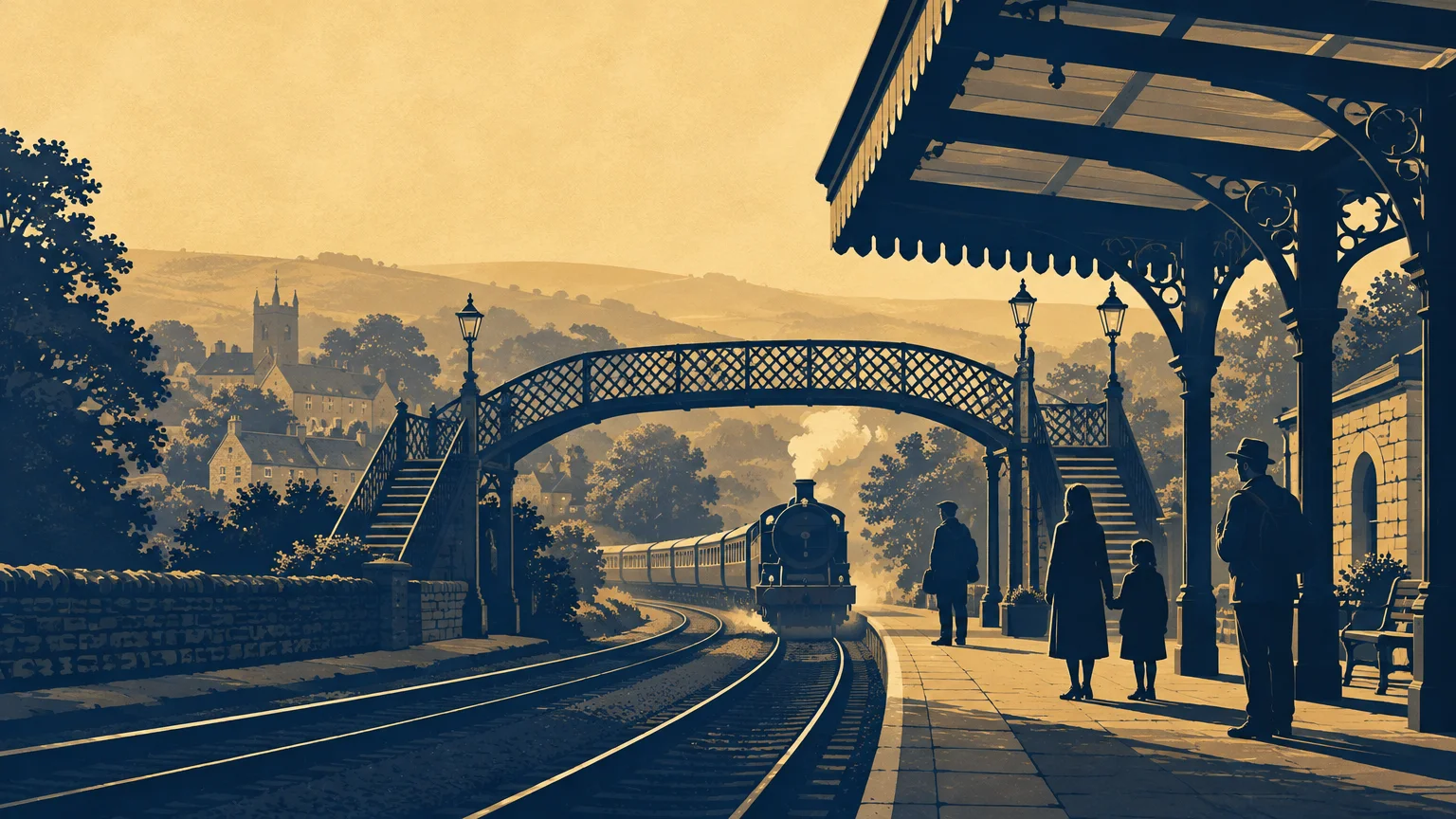
Arrive at Oakworth by train and the village introduces itself quietly. There is stonework rather than spectacle, a modest platform rather than a grand terminus, and a station building whose domestic scale suits the hills and houses around it. That modesty is part of its value. The station makes a large story—the railway’s influence on the valley—understandable through one small, carefully preserved place.
The railway gave Oakworth a new connection to the valley
Oakworth Station opened with the Worth Valley line on 15 April 1867. Historic England also dates the surviving station building to 1867. The date matters because it places the station within a period when railways were changing how settlements related to nearby towns, employment and one another.
Bradford Council’s conservation-area material describes the Worth Valley Railway as a benefit and a further catalyst for growth in villages along the valley. That does not justify attaching a precise figure to the railway’s effect on Oakworth, and the available evidence does not establish the fortunes of individual village businesses. It does, however, support a broader conclusion: the line became part of the physical and social framework within which the valley developed.
The station therefore represents more than transport history. It marks the moment when Oakworth acquired a durable railway connection with Keighley and neighbouring valley communities. Readers looking for the wider setting can begin with this introduction to Oakworth village and its local character.
Its historic character survives in unusually tangible form
Oakworth Railway Station has been Grade II listed since 4 December 1986. The Historic England listing for Oakworth Railway Station describes a single-storey stone station building, notes a later addition and records complete internal fittings restored to their original state.
Those details explain why the station can feel different from a building that merely imitates the past. Its significance rests in surviving fabric, proportion, fittings and function. Visitors can encounter railway history at human scale: the sort of rooms, surfaces and practical arrangements through which an ordinary passenger station once worked.
Listing also gives the village an officially recognised piece of architectural heritage. Yet legal protection is only part of the story. A preserved station becomes meaningful when people can understand what it was for. At Oakworth, the continuing railway operation supplies that context. A platform beside an active heritage line communicates more than an isolated building ever could.
Closure could have turned it into a relic
The station closed to passengers on 1 January 1962. It reopened under preservation on 28 June 1968, according to the Keighley & Worth Valley Railway. That six-year gap separates two very different chapters: service as part of the conventional railway network and operation as part of a preserved line.
Reopening mattered because it retained movement as well as masonry. Trains arriving and departing give the station its rhythm. Passengers wait, doors open, staff attend to the operation and the platform briefly becomes busy before settling again. This is heritage expressed through use rather than through a static display.
Preservation should not be confused with freezing a place at one imagined moment. Buildings need maintenance, visitor expectations change and facilities must be managed without overwhelming the character that makes the site valuable. Oakworth’s continuing importance lies partly in that negotiation between authenticity and present-day use.
Why Oakworth Station matters beyond The Railway Children
For many visitors, Oakworth Station is inseparable from The Railway Children. The British Board of Film Classification identifies Lionel Jeffries’ original film as a 1970 production, with its classification dated 5 November 1970. The Keighley & Worth Valley Railway says Oakworth Station was used extensively for that film and for the 2022 production The Railway Children Return.
That screen history is important. It has given generations of viewers a visual memory of the station before they ever reach the Worth Valley. Film can make details—the platform, stone building and arrival of a train—feel oddly familiar on a first visit.
But the film connection should complement rather than replace Oakworth’s local history. The station was already more than a century old when the original film appeared. It had served the valley, closed to passengers and reopened through preservation before becoming widely recognised on screen. The cinema association added another layer to the place; it did not create its significance.
Visitors drawn by the films can use that interest as a doorway into the larger story. Our practical guide to a Railway Children day trip in Oakworth and Haworth helps connect the screen locations with the railway and neighbouring village landscape.
It remains a place of arrival, activity and interpretation
The Keighley & Worth Valley Railway presents Oakworth as an operating station and publishes visitor information for it. Some provisions depend on operating days and volunteer availability, so the experience can vary with the date of travel. That variability is itself a reminder that a preserved railway depends on continuing organisation and human effort.
A dated example of investment came on 22 March 2025, when the railway announced the opening of Oakworth’s Tea Hut, Goods Yard and refurbished Goods Shed. These additions should not be treated as proof of a quantified economic effect on the village. Their more defensible significance is that they show the station continuing to evolve as a place where visitors can pause, look around and engage with railway heritage.
The station also helps people read the surrounding landscape. A rail journey reveals the shape of the Worth Valley in a way that travelling straight through by road may not. Steep ground, clustered settlements and the relationship between one station and the next become easier to grasp. On foot, the pace slows further and the railway becomes a thread through the countryside rather than an attraction viewed in isolation.
The railway describes its Railway Children Walk as a 6½-mile route beginning and ending at Haworth Station car park. It also warns that the route presents difficulties for people with limited mobility and for pushchairs, and that South Pennine conditions require suitable preparation. It is therefore better understood as a proper country walk connected with the railway story, not as a level station stroll.
What the station contributes to village identity
Village identity is rarely built from a single landmark. It accumulates through streets, buildings, stories, annual gatherings and the routes people repeatedly use. Oakworth Station contributes strongly because it brings several kinds of memory together in one place.
- It preserves fabric from the railway’s arrival in 1867.
- It recalls the loss of passenger service and the determination behind the preservation-era reopening.
- It gives Oakworth a continuing place on an operating heritage railway.
- It connects local history with a screen story recognised far beyond the village.
- It offers visitors a starting point for understanding the wider Worth Valley landscape.
These roles reinforce one another. The films encourage people to notice the station; the surviving building gives that interest historical substance; and the working railway prevents the site from becoming merely picturesque. For residents, it remains a visible reminder that Oakworth’s history belongs to a connected valley. For visitors, it offers an approachable first chapter in that story.
Plan a visit without losing sight of the place
The best way to appreciate Oakworth Station is not to rush it as a photograph stop. Allow time to notice the scale of the building, the restored details and the relationship between the platform and the surrounding village. If trains are operating, watch how the quiet station changes as one arrives and then returns to stillness.
Before travelling, check the current Keighley & Worth Valley Railway timetable and Oakworth Station information. Operating dates, train frequency, facilities, accessibility arrangements and refreshment opening can change. Walkers should also check the weather, daylight and current route conditions, and should wear footwear suitable for South Pennine paths.
Oakworth Station still matters because it allows the village’s past to remain visible without becoming remote. The building survives, the railway moves and new visitors continue to arrive with memories of a film or curiosity about the valley. The practical next step is simple: choose an operating day, confirm the current details and give the station enough time to reveal the history held in its modest stone walls.
References
- Oakworth Railway Station, Keighley – 1313962 | Historic England
- Oakworth Station – Keighley & Worth Valley Railway
- DRAFT
- Oakworth Conservation Area | Bradford Council
- BBFC | BBFC
- The Railway Children – Keighley & Worth Valley Railway
- A Delightful Addition to a Historic Gem – Keighley & Worth Valley Railway